

Magento development in Dubai
Magento and Adobe Commerce builds for UAE retailers — AED checkouts that clear local cards, 5% VAT invoices your accountant accepts, Arabic and RTL designed in from day one, and hosting in the region your buyers are in.
Magento Open Source or Adobe Commerce: which do you need?
Magento ships in two forms, and choosing between them is the first real decision of the project. Magento Open Source has no licence cost — you pay for the build, the hosting and the people who look after it. Adobe Commerce adds an annual licence priced against the size of your business, and brings B2B accounts, content staging, segmentation and supported cloud hosting.
Most Dubai retailers who ask us about Magento are well served by Open Source. The licence earns its place when you run wholesale price lists alongside retail, sell into several Gulf markets from one back office, or face a procurement team that requires a vendor support contract. We will tell you which side of that line you sit on before you spend anything — including when Magento is heavier than you need and a simpler e-commerce platform would serve you better.
What makes a Magento store work in the UAE
Payments customers here will actually complete
Base currency in AED, and 3-D Secure that behaves on mobile. Network International, Telr, PayTabs and Stripe's UAE entity all serve this market, but their Magento 2 modules are not equally mature, and several need work before partial refunds, order states and multi-store setups behave. Apple Pay matters with a phone-first audience; Tabby and Tamara change the basket-size conversation. And cash on delivery has not disappeared here — offer it and you need fraud rules, confirmation by phone or WhatsApp, and a way for your courier to reconcile cash.
VAT, tax invoices and what your licence permits
UAE VAT sits at 5%, and Magento handles it through tax classes, rules and display settings agreed before catalogue data is loaded — shoppers here expect the shelf price to be the price they pay, so prices are normally shown inclusive. What the customer downloads is a tax invoice, not a receipt: it carries your TRN and the details your accountant will ask for, so the default template gets replaced rather than restyled. Your trade licence matters too. Free-zone and mainland licences do not permit the same selling activity, and that shapes who you sell to and how you fulfil — settle it at scoping, not after launch. The same paperwork follows you to the domain: a .ae registration asks for documentation tied to your licence, so start it early rather than the week before launch.
Arabic and RTL built in, not added later
A bilingual store is architecture, not translation. Magento's store view model lets product names, attribute labels, URL keys, prices and category trees differ by language — what a serious Arabic store needs, but only if the store views exist from day one. Retrofit Arabic onto a single-view store and you are re-importing the catalogue. Right-to-left is design work too: mirrored layouts, an Arabic typeface that holds at small sizes beside the Latin one, search that copes with Arabic spelling variants, and emails and invoices in the language the customer ordered in.
Hosting close to the people buying from you
A fast Magento store needs a tuned stack: PHP-FPM sized to real traffic, MySQL indexed properly, OpenSearch for catalogue search, Redis for sessions and cache, Varnish in front, and images that are not shipped at 2MB to a phone on mobile data. Where that stack runs is a UAE question. A server in Europe adds round-trip time to every uncached request for a shopper in Sharjah or Abu Dhabi, and if customer data has to stay in the country, that is a hosting decision rather than a policy document. We host and maintain stores in the region the buyers are in.
Moving an existing store onto Magento
Migration is usually where the budget goes. Products, customers and their password hashes, order history, reviews and store credit each move differently, and a catalogue that looked fine in the old admin often holds inconsistent attributes, empty Arabic fields and duplicate SKUs. We audit the export first and tell you what is clean, what needs normalising, and what is not worth carrying across. Old URLs are redirected one to one, and both stores run until the numbers agree.
What drives the price of a Magento project
There is no list price: two stores with the same product count can differ enormously in effort. What moves the number:
- Catalogue shape — simple products are cheap; configurable variants across size and concentration, bundles, or prices that change by customer group are not.
- Languages — a second language is a second set of content, QA and emails, not a translation file.
- Integrations — ERP or accounting sync, POS stock, courier APIs, WhatsApp notifications, loyalty. Each is its own small project.
- Checkout customisation — the further it drifts from stock Magento, the more every future upgrade costs.
- Hosting and support tier — a store carrying real revenue needs monitoring and someone reachable.
How long a Magento build takes, and how it runs
Scope sets the timeline, not the platform. A clean catalogue on a configured theme with one gateway is a matter of weeks. A bilingual build with ERP integration, a custom checkout and migrated orders runs into months, and what stretches is usually data cleaning. The stages hold either way: scoping, build on a staging site you can open whenever you like, configuration of gateways, VAT rules, courier logic and bilingual emails, testing on real cards and real devices with your own team pushing orders through, then launch. Handover includes admin training, documentation and every credential in your name.
After launch: the work that keeps a store alive
Magento needs maintenance in a way lighter platforms do not. Adobe ships security patches on a schedule and third-party extensions are a standing risk, so patching is routine work. Upgrades mean checking every extension for compatibility first, and indexers, cron and cache invalidation fail quietly while taking conversion with them. Then the commercial work: catalogue expansion, campaigns for Ramadan and Dubai Shopping Festival, fixing the checkout steps analytics shows people abandoning. We take on stores we did not build, once we have read the code and can tell you what state it is in.
Retail and e-commerce work we have done
Alajlan4Oud sells perfume and oud, where one fragrance exists in several sizes and concentrations and the product page has to say so without becoming a spreadsheet. MusicGear retails instruments — high-consideration items with long specifications and stock that has to be right. Yalla Snack sells snacks to UAE customers, where basket size and delivery matter more than browsing. Outside retail: Carlly Motors in automotive, FirmaEvents in Qatar, the Arabic news platform Jadidouna, the salon brand Jamalouki, and the Relax Taxi app and video.
Talk to us about your store
We are in Dubai Internet City. Tell us where the store stands — a build from scratch, a move off another platform, or a Magento install nobody has touched in two years — and you get the scope and the number in writing first.
Magento stores we have built
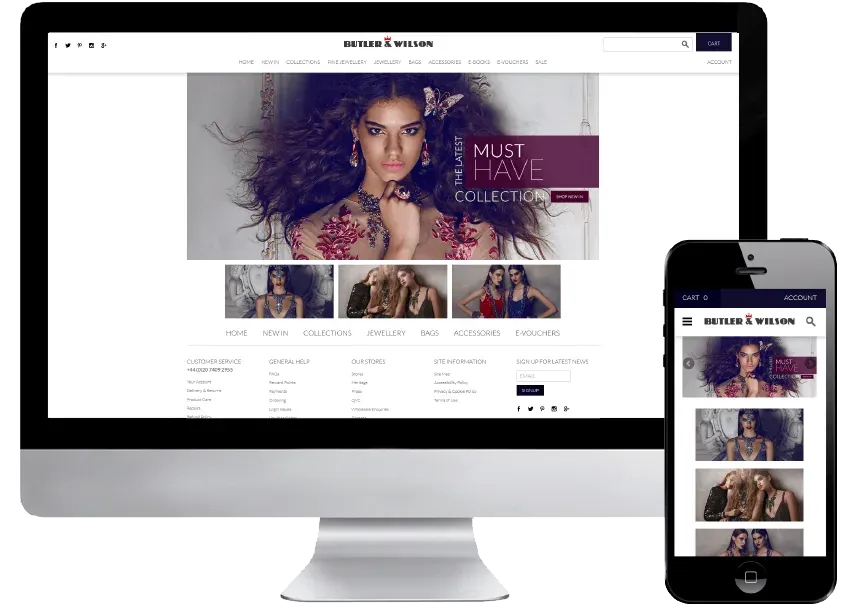
Two of the Magento catalogues we have designed and developed.

The address form Magento ships with does not fit the UAE
Stock Magento asks the buyer for a street line, a city, a state and a postcode, then validates all four. Addressing here does not work that way. Whether a postcode means anything to the courier you ship with is a question the build settles, not a field to validate by default; "state" is a fixed list of emirates rather than free text; and what gets a parcel to the door is a building name, a flat and floor, an area — Al Qusais, Al Jimi, Al Khan — and a landmark the stock form has nowhere to put. So the postcode field is made optional or removed, the region list is replaced with the emirates, and attributes are added for building and landmark.
The work is making those survive past checkout. A custom address attribute has to reach the order grid, the invoice template with whatever fields your own paperwork has to carry, the shipping label and whatever the courier's API expects — otherwise the warehouse prints an address with the building line missing. Shipping rules read the same data: table rates keyed to postcodes are dead weight, and the rules that work are written per emirate, sometimes per area within a city.
The phone number carries more weight than the second address line, because the driver calls before arriving. So validation accepts the mobile formats people type, and the field is required rather than optional. Autocomplete polishes the form; the call is what rescues a delivery.
More in this family
- DevelopmentExplore our specialized development solutions, where our experienced developers focus on crafting and supporting websites, including CMS and eCommerce platforms, as well as mobile applications. Our emphasis on performance and user-friendliness ensures functional and optimized solutions that meet your business needs. With over a decade of industry experience, we stand ready to build any product …
- Web developmentiSky builds websites, stores and custom systems from Dubai Internet City — bilingual from the first line of code, wired to the payment gateways UAE merchants actually use, and handed over in your company's name.
- WordPressWordPress built for how business actually works in the UAE: Arabic and English designed together, WooCommerce wired to UAE payment gateways and 5% VAT, and hosting and .ae domains handled properly from Dubai Internet City.
- JoomlaJoomla built for the UAE: Arabic and English from one admin, local payment gateways and 5% VAT handled properly, and an honest answer on whether Joomla is even the right platform for your project.
- E-commerceGenerate more sales on your Ecommerce website Development Solution with user focused design and functionality.
- Mobile appsAn award winning digital agency with experience in mobile app development
Have a project? Let's talk.
Tell us what you are trying to build. You will get a written scope and a price before any work starts.