Web development services in Dubai
iSky builds websites, stores and custom systems from Dubai Internet City — bilingual from the first line of code, wired to the payment gateways UAE merchants actually use, and handed over in your company's name.
What you are buying when you hire a web development company in Dubai
Design settles what a site looks like; development settles whether it holds up at 2am when someone checks out on a three-year-old phone, whether your coordinator can publish an Arabic announcement without emailing an agency, and whether you end up owning a codebase or a black box. Few businesses in Dubai buy a site for one language, one market and one payment rail: you trade under a licence, invoice with VAT, take money through a Gulf acquirer, and sell to customers who switch between Arabic and English mid-sentence.
Built for the UAE rather than translated into it afterwards
Arabic and RTL as a build requirement
Right-to-left is not a stylesheet switch flipped in the final week. Menus and validation messages mirror, directional icons flip while logos and phone numbers must not, and Arabic and Latin numerals share a line of text. We build the Arabic and English trees as equals — one content system, matching templates, separate editorial control — with hreflang set so ar-AE and en-AE read as alternates rather than copies. Jadidouna, an Arabic news site we built, is where that shows immediately.
Payments, 5% VAT and the licence behind the store
Gateways are not interchangeable. Network International's N-Genius, Telr, PayTabs and Stripe's UAE entity each carry their own onboarding, 3-D Secure behaviour and settlement flow, and which one you land on is often decided by the acquirer that will take you rather than the checkout you liked. We scope it before the build, not after. Tax works the same way: shelf price, cart total and invoice must handle 5% VAT consistently, because a store showing a VAT-inclusive price that then adds it again loses the order.
.ae domains, UAE hosting and where the data sits
A .ae domain is administered under UAE rules and registrars normally want trade-licence documentation, so start that paperwork early, not in launch week. Hosting asks more than a speed question: a server inside the UAE shortens the round trip for Gulf visitors and settles where customer records physically sit — which surfaces the moment a government client or a procurement team asks. Mainland or free-zone licensing, whether DMCC, IFZA or Dubai Internet City, also shapes the trading name that belongs on your invoices.
What drives the price of a web development project
- Not page count. Twenty near-identical pages cost less than five that behave differently.
- Bilingual depth. A mirrored interface is one cost; letting Arabic and English content diverge is another.
- Integrations. Gateway, ERP, POS, stock feed, courier tracking, CRM, WhatsApp routing.
- Custom versus platform. WordPress, Joomla and Magento carry a great deal for free; bespoke code carries nothing.
- Content readiness. Whether photography, product data and Arabic copy exist or need writing.
- Migration. URL mapping, redirects, and protecting traffic an existing site already earns.
- Life after launch. Hosting, monitoring, backups, and who answers when something breaks.
We publish no price list, because a bilingual brochure site and a Magento store wired into a warehouse are not one product. Tell us what you want built and you get a written scope with a price against it.
How long it takes, and what usually delays it
Writing code is rarely the long pole. Schedules slip on three predictable things: content, usually the Arabic copy nobody has been assigned to write; third-party approvals, since merchant-account and gateway onboarding sits with your bank and moves at the bank's pace; and unmade decisions about product data or sign-off. Dates go in the scope, with the ones that depend on you marked plainly.
How a build runs
- Scope. Templates, languages, integrations, hosting and what is explicitly out, written down first.
- Structure and design. Sitemap and interface, reviewed in both reading directions. Sign-off happens here, where changes are cheap.
- Build. Front end, content system, integrations and admin roles, on a staging URL you can open any day.
- Testing. Real devices, both languages, forms, speed, accessibility, checkout against the gateway sandbox.
- Handover. Code, hosting and admin credentials in your company's name, plus training for whoever runs it.
What a build includes
- A layout built for the phones your customers actually hold
- A content system with user roles, so an intern cannot delete the pricing page
- Arabic and English as first-class versions, correctly marked up for language and direction
- Crawlable markup, metadata, structured data, sitemaps and migration redirects
- Analytics and conversion tracking set up before launch, not months after
- Measured performance work, SSL, hardening, spam protection and backups
Which platform, and when to build from scratch
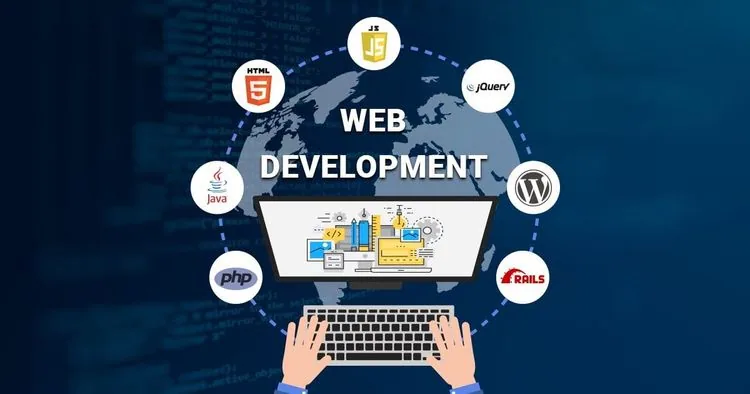
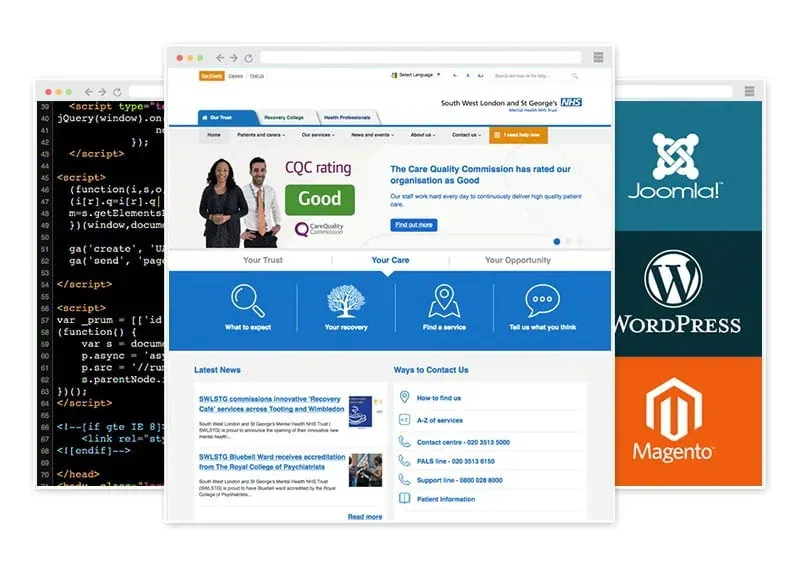
Most projects belong on an established platform. WordPress suits content-led sites and teams who publish often, Joomla earns its place on structured multilingual sites with layered access, and Magento is where serious catalogues and complex tax and shipping logic live. Custom development is for the case none of those fit: a portal, an internal tool, a dispatch system with rules specific to your operation.
Work we have built
Alajlan4Oud sells perfume online, where variants, gifting and repeat buyers shape the catalogue. MusicGear is instrument retail, where stock moves one unit at a time. Yalla Snack is UAE snack retail, Carlly Motors is automotive, where the enquiry matters more than the cart, and Jamalouki is a salon built around appointments. FirmaEvents runs events in Qatar, and Relax Taxi paired a taxi app with video production.
After launch
Platforms ship security patches, payment providers change APIs, and a site untouched for a year becomes the easiest target on its server. Maintenance, monitoring, backups, hosting and security are available as an ongoing arrangement, or hand the lot to your own developer.
Questions UAE clients ask
Do we own the code and the accounts?
Yes. Domain, hosting, content system and third-party accounts are registered to your company, and the code is yours on final payment. You should be able to move to another agency without asking us.
Will this put us at the top of Google?
Nobody can promise a position, and be wary of anyone who does. Development controls the technical half: speed, crawlability, correct markup in both languages, and the absence of faults that keep pages out of the index. Where you land after that is a content and competition question, which our SEO team handles separately.
We are a new free-zone company still waiting on the bank. Can we start?
Yes, and it is a common sequence: design, build and content run while licensing and merchant onboarding proceed alongside, and payment goes live once the acquirer clears you.
iSky works from Dubai Internet City. Tell us what you are trying to build and we will come back with a scope, a plan and a price.
Development work
Sites and applications built by our development team.
Building right to left: what mirrors, what must not
On a bilingual UAE build, direction is not a switch thrown at the end; it is decided per component. We write spacing and alignment as logical properties — start and end, not left and right — so one stylesheet serves both. Then the exceptions get named: a phone number, an IBAN or a Latin product code keeps its own direction inside an Arabic line, and icons divide in two. A back arrow flips; a play button, a clock face and the logo do not.
Borrowed components come next. A date picker, a slider or a chat launcher assumes the page begins on the left. In Arabic the calendar can open past the edge of the screen, the slider can advance away from the reader, and that button lands on whatever the mirrored layout puts in the corner. We test each third-party piece in Arabic before adopting it, and count replacing a stubborn one as part of the work.
Arabic also declines tools an English interface leans on. It has no capitals, so a style that shouts in uppercase has no Arabic equivalent, and letter-spacing breaks the joins between letters, so it is switched off rather than inherited. A label cut to fit a button in one language may not fit in the other: components are built to stretch, and the language attribute goes on the element, not the page alone. We read both directions on a real screen at the narrow breakpoints, where a mirrored layout runs out of room first.
More in this family
- DevelopmentExplore our specialized development solutions, where our experienced developers focus on crafting and supporting websites, including CMS and eCommerce platforms, as well as mobile applications. Our emphasis on performance and user-friendliness ensures functional and optimized solutions that meet your business needs. With over a decade of industry experience, we stand ready to build any product …
- WordPressWordPress built for how business actually works in the UAE: Arabic and English designed together, WooCommerce wired to UAE payment gateways and 5% VAT, and hosting and .ae domains handled properly from Dubai Internet City.
- JoomlaJoomla built for the UAE: Arabic and English from one admin, local payment gateways and 5% VAT handled properly, and an honest answer on whether Joomla is even the right platform for your project.
- MagentoMagento and Adobe Commerce builds for UAE retailers — AED checkouts that clear local cards, 5% VAT invoices your accountant accepts, Arabic and RTL designed in from day one, and hosting in the region your buyers are in.
- E-commerceGenerate more sales on your Ecommerce website Development Solution with user focused design and functionality.
- Mobile appsAn award winning digital agency with experience in mobile app development
Have a project? Let's talk.
Tell us what you are trying to build. You will get a written scope and a price before any work starts.